Academic Publications
Gang, S. (in print). “Then I chose to play Confucian Boy”: Korean Queer Gamers’ Virtual Migration across Online Gaming Spaces. European Journal of Korean Studies.
Gang, S. (2026). Experiences of placelessness: Rethinking queer economies and everyday exclusion in South Korea. Historical Social Research.
Gang, S., Löw, M., Song, A. & Stollmann, J. (2025). Can you pass? Threshold spaces and queer everyday struggles in Seoul. Space and Culture. (Corresponding author)
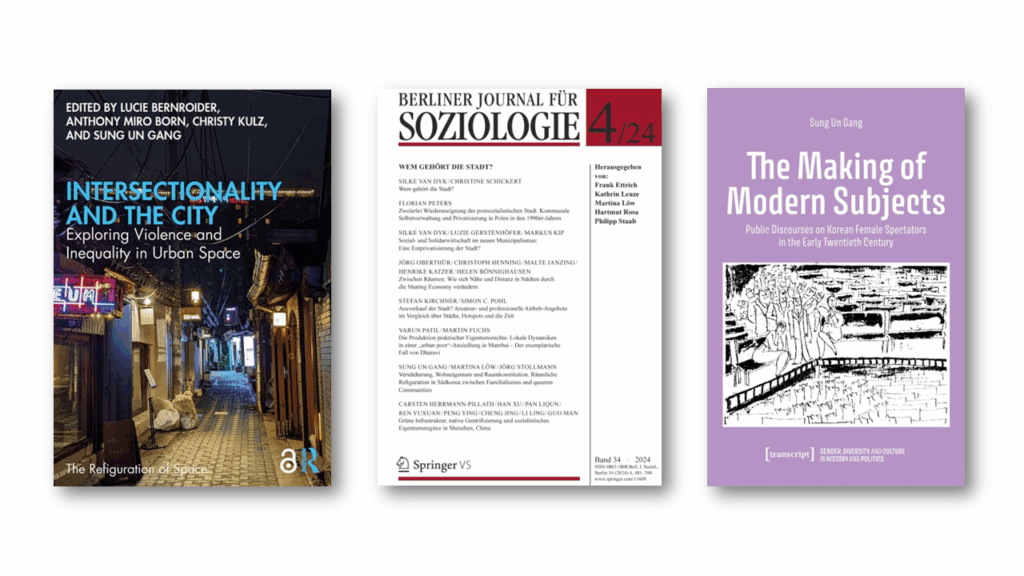
Bernroider, L., Born, A.M., Kulz, C. & Gang, S. (2025). Intersectionality and the City: Exploring Violence and Inequality in Urban Space. London & New York: Routledge.
Bernroider, L., Born, A.M., Kulz, C. & Gang, S. (2025). Introduction: Exploring urban violence and inequality from intersectional perspectives. In L. Bernroider, A.M. Born, C. Kulz & S. Gang (Eds.), Intersectionality and the City: Exploring Violence and Inequality in Urban Space (pp. 1–12). London & New York: Routledge.
Gang, S. (2025). Only a researcher’s struggle? Reconceiving the ethnographic field as a relational space. In L. Bernroider, A.M. Born, C. Kulz & S. Gang (Eds.), Intersectionality and the City: Exploring Violence and Inequality in Urban Space (pp. 42–52). London & New York: Routledge.
Gang, S. (2025). The linguistic strategy of post-migrant theatre in Germany: The case of Olivia Hyunsin Kim’s History has failed us, but… (2022)]. Koreanische Zeitschrift für Germanistik, 174. [Original in Korean]
Gang, S. (2025). Don’t litter on my parade. In I. Fariás, S. Steets & N. Gansterer (Eds.), Atlas of Spatial Figures: Exploring Spaces of the Contemporary (pp. 104–105). Berlin: Jovis.
Gang, S. (2025). We are everywhere. But where are we? In I. Fariás, S. Steets & N. Gansterer (Eds.), Atlas of Spatial Figures: Exploring Spaces of the Contemporary (pp. 50–51). Berlin: Jovis.
Gang, S., Löw, M. & Stollmann, J. (2024). Verstädterung, Raumkonstitution und Eigentumserwerb. Räumliche Refiguration in Südkorea zwischen Familialismus und queeren Communities [Urbanisation, spatial constitution, and property acquisition. Spatial re-figuration in South Korea between familialism and queer communities]. Berliner Journal für Soziologie, 34, 647–672.
Gang, S. (2024). The Making of Modern Subjects: Public Discourses on Korean Female Spectators in the Early Twentieth Century. (Gender, Diversity, and Culture in History and Politics 3). Bielefeld: transcript.
Gang, S. (2023). Liebesfilme, Geschlechtskrankheiten und eugenische Ehe: Diskurse über Seouler Kinobesucherinnen in den 1920er- und -30er-Jahren [Romance films, sexually transmitted diseases, and eugenic marriage: Discourses on female cinema-goers in Seoul in the 1920s and 1930s]. Österreichische Zeitschrift für Soziologie, 48, 221–242.
Gang, S. (2023). Safe(r) Space. In S. Pertsch (Ed.), Vielfalt. Das Andere Wörterbuch. 100 Wörter – 100 Menschen – 100 Beiträge [Diversity. The Other Dictionary. 100 Words – 100 People – 100 Contributions] (pp. 192–193). Berlin: Duden.
Gang, S. (2021). From streets to theaters: The emergence of the Korean entertainment business in the early 20th century. In H. Meyer, S. Yukawa & N. Bachem (Eds.), Ostasien im Blick: Festschrift zum 60. Geburtstag von Reinhard Zöllner [East Asia in Focus: Festschrift for the 60th Birthday of Reinhard Zöllner] (pp. 145–166). Großheirath: Ostasien Verlag.
Gang, S. (2020). Corona, a Summer Hole. In J. Ch’oe et al. (Eds.), Hyphen: The Corona Affect. Das Beiblatt von Literature and Society (pp. 183–203). Seoul: Munhak kwa chisŏng sa. [Original in Korean]
Gang, S. (2020). “Corona!” Experiences of Asian people: The racism problems the virus exposed. In E. Park (Ed.), Post-Corona Society. Pandemic Experiences and a World that Changed (pp. 85–93). P’aju: Kǔl hang’ari. [Original in Korean]